As a native Floridian, I can proudly say The Sterling Council is Florida’s best-kept secret. Sterling is the Florida/Georgia state-level member of the National Malcolm Baldrige alliance. It is powered by the Baldrige Excellence Framework, the same framework that has been adopted and adapted by over 80 countries, has a reported return on investment of 820:1, and has been called one of America’s greatest investments by the U.S. Department of Commerce. It’s a continually improving, evidence-based model for organizational performance excellence and a key driver for job growth in the nation and here in my home state of Florida.
I was lucky enough to be introduced to Sterling examiner training through a scholarship from my local ASQ (American Society for Quality) section. A colleague who encouraged me to apply put it best:
“Going through the training and later an assessment is like obtaining two organizational behavior degrees.”
He wasn’t wrong. Sterling training gives examiners the ability to see past the trees and into the forest of an organization’s operating system. To recognize how seemingly unrelated business processes are actually connected, how they mature, and how they work together to drive performance. The training immediately gave me tools that I took back to my clients, routinely placing me as a recurring special guest at strategic planning sessions and monthly board meetings, sharing insights and examples of what best-practice organizations actually do.
That alone has been valuable. But the more training and assessments I complete, the more I find that Sterling isn’t just about leadership skills, systems thinking, or deepening an understanding of the performance excellence criteria. Maybe even more important is the camaraderie. The people in Sterling are built differently. They’re sharp, engaged, and they show up to volunteer their time and expertise.
Examiners get to work alongside SVPs of healthcare systems, directors of strategic planning, management consultants, VPs of human resources—you name it, there is an expert at Sterling. It’s not just rubbing shoulders; these incredible people become coworkers and friends. Talk to any examiner long enough and you’ll hear a version of the same story: they were handed a stretch goal with no idea where to start, so they turned to their Sterling network, called up a friend, and got the kind of help that normally comes with a several-thousand-dollar price tag. Power BI rollouts finished six months ahead of schedule. Strategic planning processes benchmarked against actual role-model organizations, starting with a best-practice example instead of designing from nothing.
I’ve lived this myself. When I was tasked with implementing a cNPS (customer Net Promoter Score) survey, I called a healthcare system COO I’d met through Sterling who had built and matured their voice-of-the-customer program years prior. I delivered a survey program design in a week, instead of months of back-and-forth with a committee that also had no prior experience setting one up.
The exchange goes both ways, too. When a colleague was asked to stand up a PMO, he called me. We talked through my experience building operational and enterprise PMOs. I shared the maturity model we used, hiring insights, and the lessons I learned the hard way, so he could design his program around evidence and wisdom instead of trial and error.
In the beginning, I would have shared that being a Sterling examiner was all about professional development and building leadership skills. As the years go on, I find myself valuing the network even more. The people I meet as fellow examiners are my colleagues; they are my friends. We help each other navigate the challenges of complex organizational problems, and we show up to celebrate each other’s wins and promotions along the way.
I signed up again this year to be an examiner partly because I want to see what new role-model organization I get the privilege to assess and learn from, and to satisfy my ASQ and PMI recertification credits. But most importantly, I signed up to meet my future colleagues, friends, and potentially even business partners—people I get to learn from and share knowledge back with.
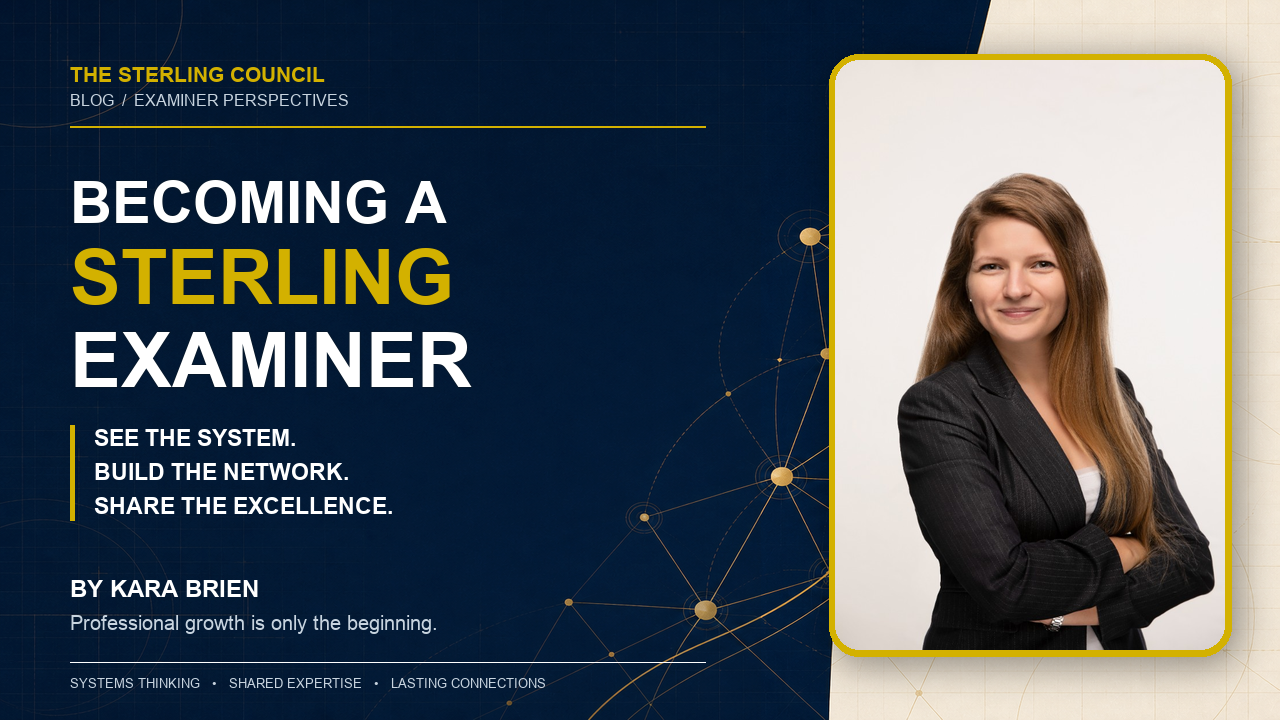
To anyone who values performance excellence, whether you’re on the front line or a senior leader, this is the place to be. If you haven’t already, join the Board of Examiners to learn what best-practice organizations do and build a good, honest, high-performing network while you’re at it.