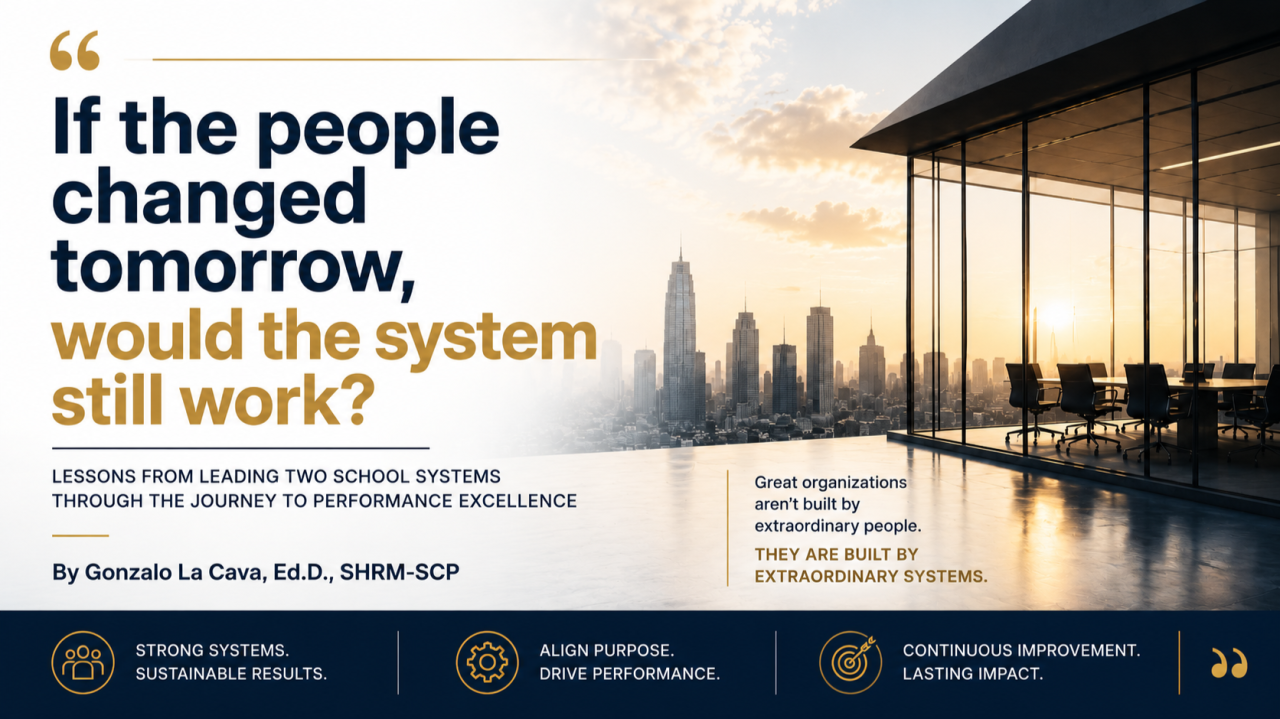
“If the people changed tomorrow, would the system still work?”
That is the first question I ask leadership teams when we begin a conversation about organizational excellence.
The room usually becomes quiet.
Most leaders know the answer before anyone says it.
Throughout my career, I’ve watched talented people accomplish extraordinary things. I have watched leaders step up during difficult moments, employees find creative solutions, and teams overcome challenges through dedication and commitment.
But over time, I realized something that changed the way I lead.
Extraordinary organizations cannot depend on extraordinary people alone
People change. Leaders retire. Employees move on. Priorities evolve.
The question is whether the organization has built the systems, processes, and culture necessary to continue succeeding when those changes occur.
That realization has shaped the way I lead.
The First Journey
Several years ago, I had the opportunity to help lead a large urban school district through the Governor’s Sterling Award assessment, Florida’s performance excellence program based on the nationally recognized Baldrige Excellence Framework.
At the time, we believed we were doing many things well. We had dedicated employees, innovative programs, and leaders deeply committed to students and staff.
The assessment did not tell us that we were failing.
Instead, it showed us where we could become better.
The greatest challenge was not effort. It was alignment.
Departments were working hard, but sometimes in isolation. Strategic priorities were not always connected across the organization. Data existed, but it was not always being used to drive improvement. Too much success depended on individual leaders rather than systems designed to create consistent results.
That experience changed my perspective.
We began aligning strategy, strengthening leadership practices, connecting performance measures, improving workforce systems, and creating a culture of continuous improvement.
The Governor’s Sterling Award was a meaningful recognition, but the award itself was never the most important outcome.
The greatest accomplishment was building an organization that became stronger because of its systems—not dependent on any single person.
That experience taught me that great organizations are not built simply by finding extraordinary people. They are built by creating systems that allow people to do extraordinary work.
The Journey Continues
Recently, as Chief Human Resources Officer for Fulton County Schools, I had the privilege of leading Fulton County Schools through the Georgia Oglethorpe Award assessment, administered by The Sterling Council and based on the Baldrige Excellence Framework.
This journey reinforced many of the lessons I had learned years earlier, but it also reminded me that every organization has its own story.
We did not approach the assessment as something to complete or a recognition to pursue. We approached it as an opportunity to better understand how our organization worked and where we could improve.
As we aligned strategy, strengthened processes, and focused on meaningful outcomes, the results followed.
Within Human Resources, teacher vacancies declined to less than 1 percent, employee retention increased to 89 percent, and employee engagement improved from the mid-50s to 77 percent.
Those results were not created by one initiative or one individual.
They came from people, processes, and strategy moving together toward a shared purpose.
We didn’t achieve those outcomes by launching dozens of disconnected initiatives. Instead, we focused on aligning our strategy, strengthening leadership accountability, listening to employees, measuring what mattered, and continuously improving our systems. Small improvements, repeated consistently, produced meaningful organizational change.
That is what performance excellence means to me.
It is not about winning an award.
It is about building an organization that continues improving long after today’s leaders leave.
Why This Matters More Than Ever
Public education is facing unprecedented complexity.
School systems are navigating staffing challenges, financial pressures, increased accountability, changing community expectations, and an endless stream of competing priorities.
The challenge is rarely a lack of ideas.
The challenge is creating alignment.
Organizations often add new programs without asking whether those efforts connect to a larger strategy or whether existing systems are designed to support success.
Performance excellence requires leaders to ask a different question.
Not:
“What should we do next?”
But:
“How can everything we are already doing work together better?”
That shift changes how organizations improve and how they serve the people who depend on them.
Lessons That Have Stayed With Me
Purpose must guide decisions.
The strongest organizations are clear about why they exist.
Purpose is not simply written in a strategic plan or displayed on a wall. It becomes the filter leaders use to prioritize resources, make difficult choices, and connect employees’ daily work to a greater mission.
Leadership creates culture.
Frameworks do not transform organizations. People do.
Leaders build trust, develop others, model expectations, and create environments where improvement can happen.
Across both performance excellence journeys, I learned that leadership behavior was often more important than the strategy itself.
Systems should outlast people.
This lesson continues to influence how I lead.
Organizations should absolutely celebrate exceptional employees. They should recognize innovation, commitment, and excellence.
But exceptional organizations create systems that allow success to continue regardless of who occupies a particular role.
The goal is not to become indispensable.
The goal is to build something that lasts.
Data should create learning, not simply accountability.
Most organizations collect information.
Far fewer use data to truly improve.
The strongest organizations use data to understand what is working, identify challenges, listen to employees and communities, and make better decisions.
When leaders use data as a tool for learning rather than judgment, continuous improvement becomes part of the culture.
The Legacy of Leadership
People often assume organizations pursue performance excellence awards because they want recognition.
Recognition is meaningful, but it has never been the destination.
The real pursuit is something deeper:
- Better leadership.
- Better systems.
- Better alignment.
- Better outcomes for the people we serve.
Leading two school systems through performance excellence journeys has reinforced one belief above all others:
Leadership is not measured by how indispensable we become.
It is measured by what continues after we are gone.
Every leadership decision we make should move our organizations one step closer to answering “yes” to one important question.
People will change. Leaders will transition. Priorities will evolve.
The organizations that thrive are those that have built systems and cultures strong enough to sustain excellence.
So I leave you with the same question that continues to guide my work.
“If the people changed tomorrow, would the system still work?”
Used with permission. Originally published on LinkedIn.